


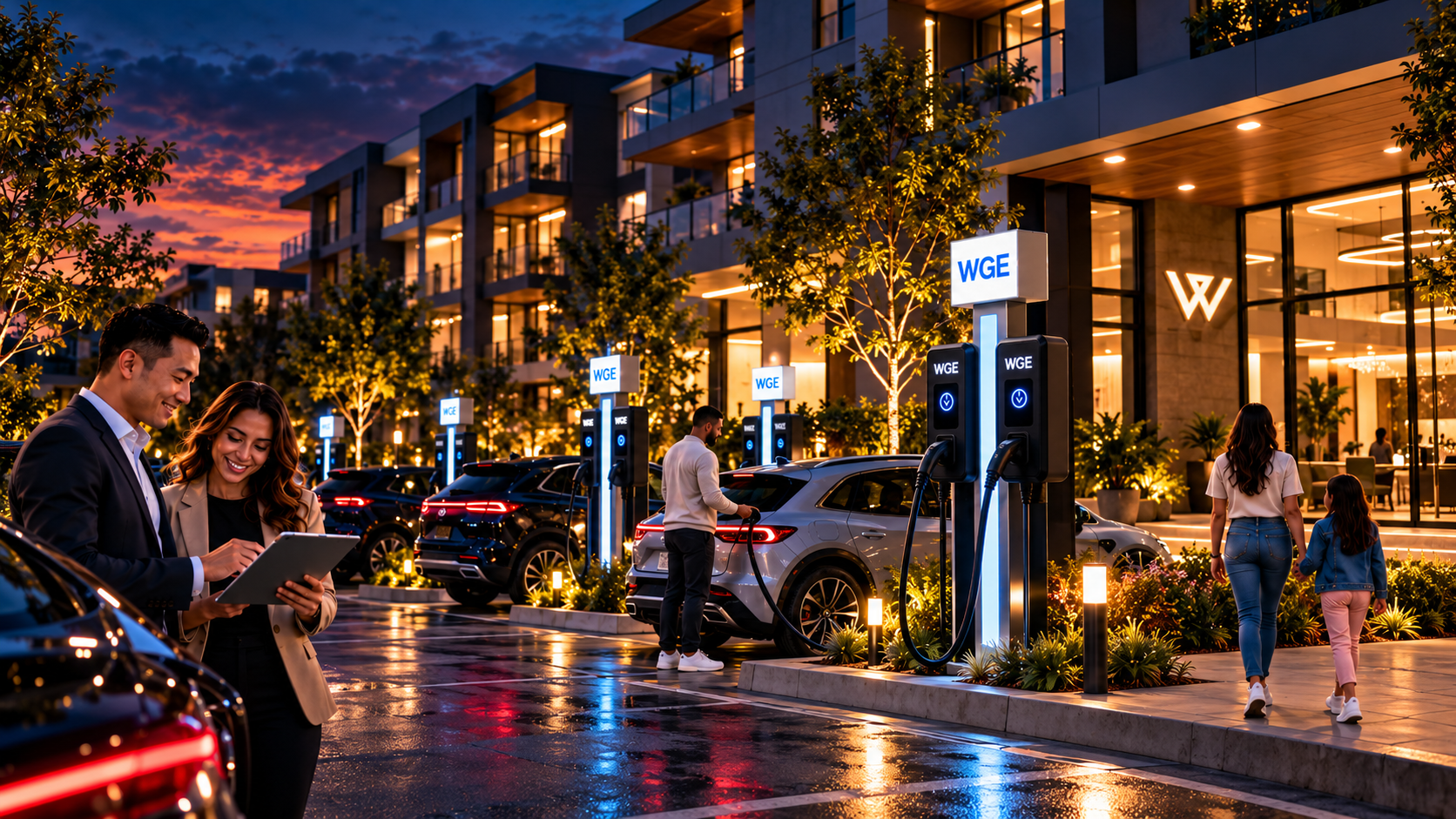
EV charging at an apartment or condominium property is not only a question of how many chargers to install.
One of the most important decisions is how residents and visitors will actually use them.
A multifamily property may choose shared charging spaces, chargers assigned to specific parking stalls, guest or public-facing charging, or a combination of several approaches. The right model depends on the parking layout, resident behavior, electrical capacity, access rules, property operations and long-term demand.
That makes multifamily charging an infrastructure and property-management decision — not simply an equipment purchase.
Start with the people who will use the chargers
Before choosing hardware, define the likely users. Will charging primarily serve residents? Do residents have assigned parking? Are there visitors, staff or public drivers who may also need access? How often do residents drive and how long are vehicles parked overnight?
These questions influence where chargers should be located, how access should be managed, whether payment or usage tracking is needed and how many ports may be required.
Model 2: Assigned charging
Assigned charging dedicates a charger or charging-capable parking space to a specific resident, unit or parking assignment. It can provide a simpler day-to-day experience for drivers because the charging location is predictable.
The tradeoff is that electrical distribution, parking assignments, billing, equipment ownership and future turnover should be considered carefully. A charger tied too closely to one current resident's vehicle or parking arrangement may create unnecessary limitations later.
Assigned charging may fit when
- Residents already have assigned parking
- The property wants a dedicated amenity for specific units
- Charging can be planned as part of parking or lease administration
- Electrical infrastructure can support the layout
Model 3: Guest or public-facing charging
Some multifamily properties may also want chargers for visitors, prospective tenants, staff or the public. This can expand the role of the charging infrastructure beyond resident-only use.
Public-facing or guest charging introduces additional operating questions: Who can access the charger? Is charging free or paid? How are spaces marked? Who responds to faults or blocked spaces? Does the property want reporting or payment capabilities?
Electrical capacity shapes every model
Shared, assigned and public charging can all be constrained or enabled by the property's electrical infrastructure. A site review should consider existing service and panel capacity, the number of proposed ports, charger power, distance to parking, expected simultaneous use and future expansion.
The correct approach is not to assume that more chargers automatically require a specific upgrade. It is to understand the property first and design around verified conditions.
Parking layout matters as much as charger count
A charger has to work with the way residents actually park. Conduit routes, cable reach, accessible spaces and routes, traffic circulation, signage, equipment protection and future parking changes can all affect placement.
For garage properties, the relationship between charging spaces and electrical rooms can be particularly important. Outdoor lots create a different set of routing, weather and equipment-protection considerations.
Think about billing, access and operations
Multifamily charging is an ongoing service. Properties should decide whether residents authenticate, whether charging is included as an amenity or separately billed, how access is restricted, who supports the equipment and how usage is monitored.
Networked charging can support some of those needs, but features should be selected because they fit the operating model — not simply because they are available.
Plan for growth without overbuilding
A property may begin with a limited number of EV drivers and see demand increase later. Future-ready planning can include conduit pathways, reserved capacity, scalable networking, parking layouts and a phased deployment strategy.
The goal is to create a first phase that works now without making the next phase unnecessarily difficult.
Which model is right for your property?
There is no universal answer. Shared charging may provide flexibility. Assigned charging can simplify the resident experience. Guest or public charging can broaden access. Many properties may ultimately use a combination.
The best model starts with the property's residents, parking system, electrical infrastructure, operating goals and expected growth.
Plan multifamily charging with WGE
Welsh Global Energy approaches multifamily EV charging as a property-specific infrastructure project. WGE helps evaluate the site, charging use case, electrical capacity, equipment, placement, access and long-term expansion needs.
Exploring EV charging for an apartment or condominium property? Learn more at WelshGE.com.
Energy Everywhere You Go.
Frequently asked questions
What is the best EV charging setup for an apartment building?
It depends on resident parking, electrical capacity, number of EV drivers, access rules and future demand. Shared, assigned and public charging can each fit different property models.
Can apartment EV chargers be shared by multiple residents?
Yes. Shared charging can be an option when the property uses common charging spaces and has an operating plan for access, availability and vehicle movement.
Can a condo install chargers in assigned parking spaces?
Assigned charging may be possible depending on the property, electrical infrastructure, ownership rules, parking arrangement and local requirements. Site-specific review is important.
Should multifamily EV charging include payment or access control?
That depends on whether charging is a free amenity, resident-only service, separately billed utility, guest service or public offering.
How many chargers should a multifamily property install?
There is no universal number. Current demand, parking behavior, dwell time, available power and expected growth should guide the first phase.
Should the property plan for more chargers later?
Yes. Even if the initial installation is small, conduit, capacity, networking and parking layout can be considered with future expansion in mind.